
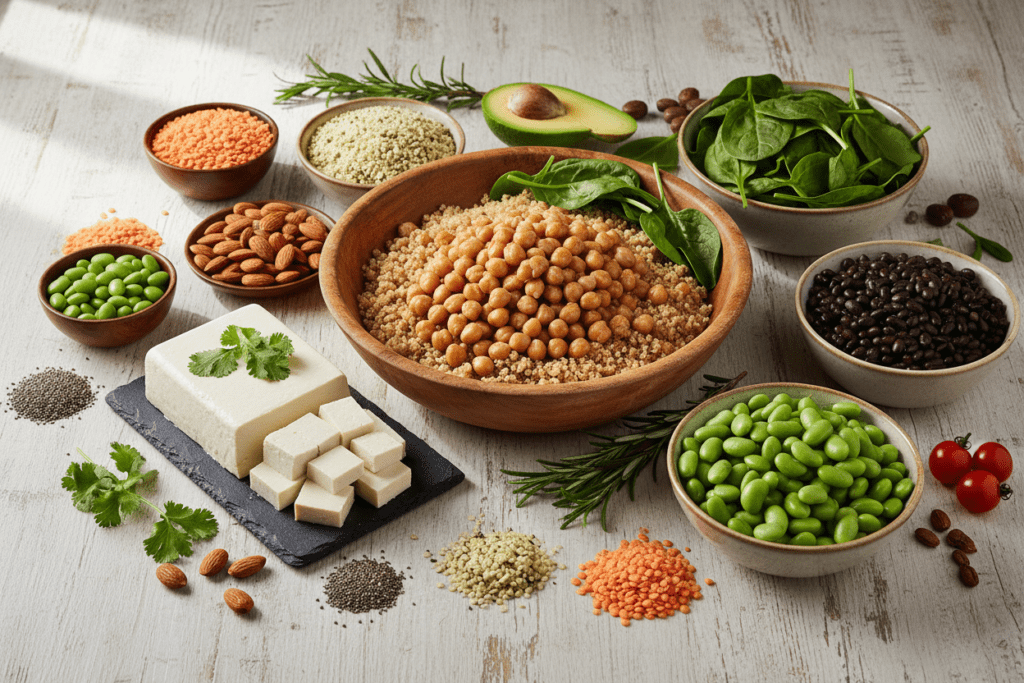
Most of the time when we talk about protein, the first question is, “How many grams does it have?” You see it on every label, every bar, every shake. But if you’ve ever hit your protein goal and still felt tired, bloated, or constantly reaching for snacks, you already know there’s more to it than a number.
Protein in nature doesn’t come alone. It usually shows up wrapped in something that looks like actual food beans, lentils, seeds, nuts, whole grains. When you eat those, you’re getting protein plus fiber, healthy fats, minerals, and all kinds of plant compounds your body quietly depends on. That full package is what helps steady your energy, support your gut, and keep you feeling satisfied for more than an hour.
Protein isolates are a different story. To make them, manufacturers take a protein‑rich food and strip away almost everything except the protein. What’s left is a concentrated powder that gives you a BIG NUMBER on the label, but much less of the natural context it originally lived in. It’s efficient, and there are moments when that’s helpful but it’s not the same as eating protein in its whole‑food form.
You can feel the difference. A bowl of beans, veggies, and some avocado tends to sit in your system in a grounded, stable way. A quick isolate shake might take the edge off, but it doesn’t always carry you very far. Without the built‑in fiber and fats, it can land more like a shortcut than a full meal, especially for your gut and blood sugar.
This is a big part of why Joulebody chose not to include protein isolates in our formulation. We wanted to be cautious with gut health, knowing how much the microbiome is shaped by what we eat day after day. We also wanted to avoid layering in more highly processed components that could add to everyday exposure to endocrine disruptors. Keeping the protein inside real, recognizable foods felt like the more conservative, respectful choice for the body.
Just as importantly, we wanted to be transparent. When Joulebody makes claims about how our products support energy, mood, or digestion, we want those claims to be rooted in real food, not in a cocktail of isolates and additives that’s hard to decode. Whole ingredients are easier to understand and easier to trust: what you see on the label actually matches what your body is getting.
- Often called cold-processed, cold-filtered, cross‑flow or microfiltered; these are mechanical, water-based filtration methods using membranes, not harsh solvents.
- They aim to protect protein integrity and avoid ion‑exchange chemistry with strong acids and bases.
- Terms like ion exchange on product pages indicate use of chemicals such as hydrochloric acid and sodium hydroxide to separate proteins.
- Vague marketing with no mention of processing method at all can also mean standard high‑heat, chemically assisted processing.
- Phrases such as “cold‑processed,” “cold‑filtered,” “microfiltered,” “cross‑flow filtered,” “mechanically filtered,” “no ion‑exchange” are good signs.
- Brands that emphasize low‑temperature processing, “undenatured protein,” and “no harsh chemicals/solvents” are typically using water-based mechanical filtration