
5 Wellness Lies I Bought Into for Years (And What’s Actually True)
If you saw our recent Instagram post about the 5 wellness lies I bought into for years, you already know the response was a lot. Hundreds of you commenting “I believed all 5,” tagging your friends, DM’ing us about which one hit the hardest. It clearly struck a nerve. So we’re circling back here on the blog with the long version, the why, and what’s actually true.
A quick disclaimer before we get into it: I’m not coming at this from a place of judgment. I bought into all five of these for years. I built habits around them. I made decisions about my body based on them. And it took years of working in wellness, formulating products, and listening to my own body to realize how much of what gets passed off as “healthy” is just outdated, oversimplified, or flat-out wrong especially for women.
If you’ve ever felt like you’re “doing everything right” and still feeling tired, bloated, foggy, or stuck there’s a good chance one of these is part of it. Let’s get into them.
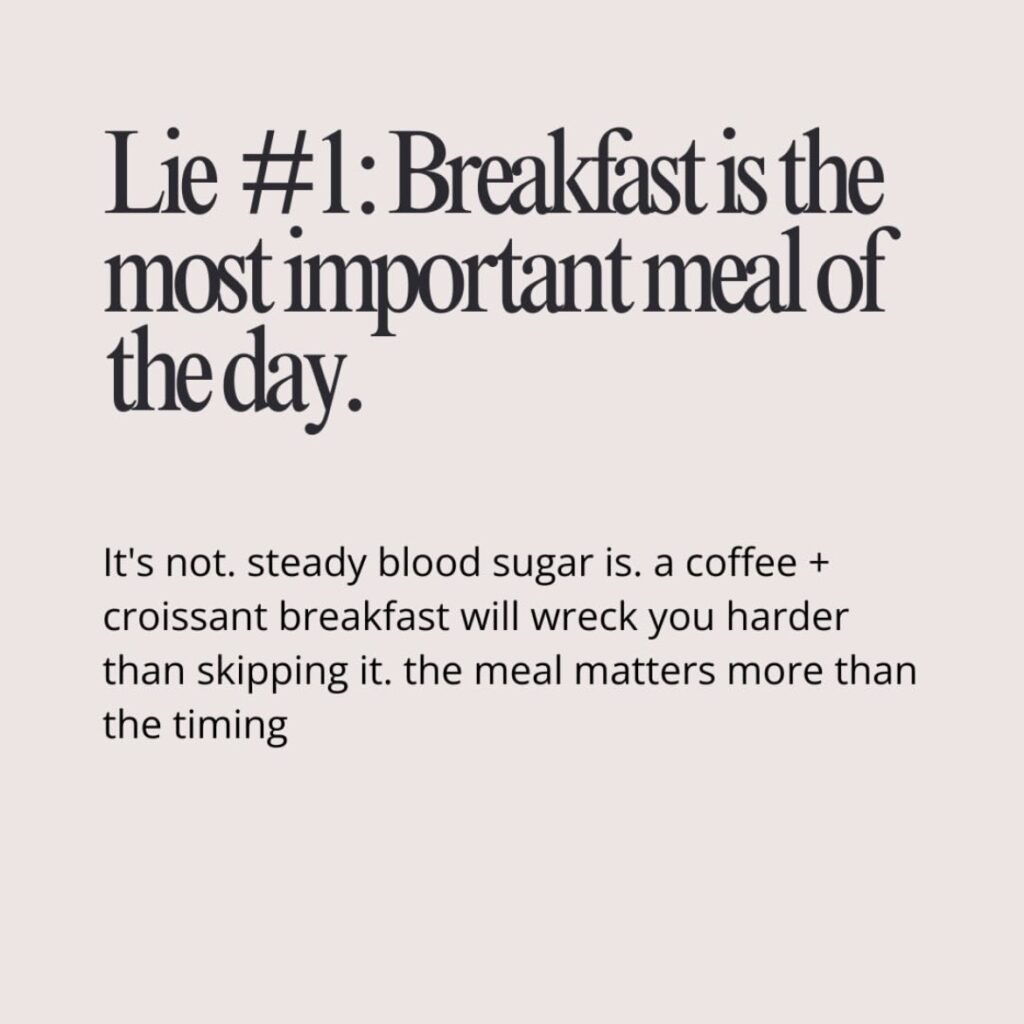
Lie #1: Breakfast Is the Most Important Meal of the Day
You’ve heard this your entire life. Skipping breakfast will tank your metabolism. You can’t think without it. You’ll be ravenous later. Eat first thing.
Here’s the thing it’s not the meal that’s important. It’s what you eat and how steady you keep your blood sugar throughout the day.
A coffee and a croissant breakfast (or a granola bar, or a sugary “yogurt parfait,” or oat milk latte plus a muffin) will wreck you harder than skipping breakfast altogether. Why? Because you’ve just sent your blood sugar straight into orbit on an empty stomach, with no protein, fat, or fiber to slow the spike down. The crash that follows is what’s causing your 10am brain fog, your 11am snack cravings, and your “why am I starving again” by lunch.
The truth: steady blood sugar is the most important thing. A real, hormone-supportive first meal built around protein, healthy fat, and fiber gives your body something to work with. Eggs and avocado. A smoothie with real protein, nut butter, and seeds. Greek yogurt with chia and berries. A Joulebody bar with a glass of water if you’re running out the door.
If you’re someone who genuinely isn’t hungry until later in the morning, that’s also fine. The meal matters more than the timing. Forcing food down at 6am because someone told you to isn’t doing your hormones any favors. Listen to your body, eat well when you do eat, and stop spiking your blood sugar first thing in the morning.
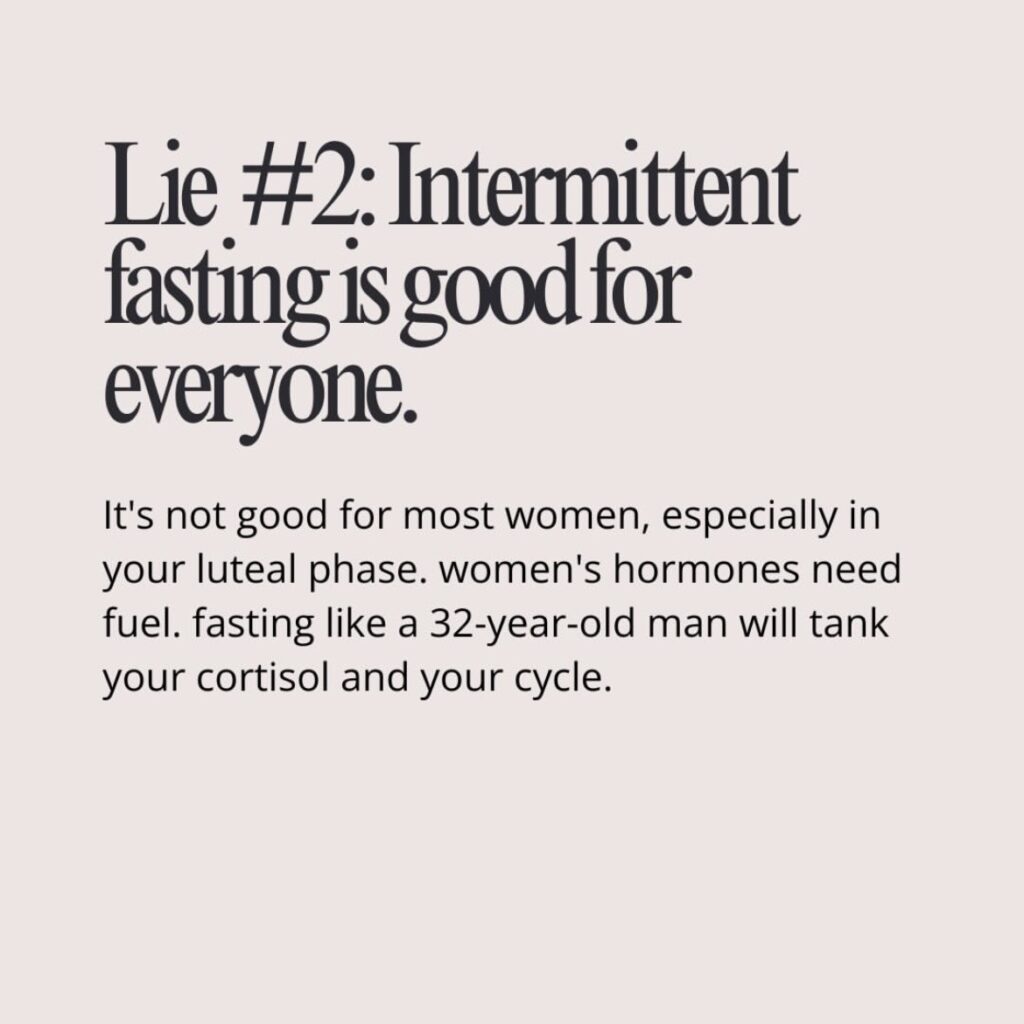
Lie #2: Intermittent Fasting Is Good for Everyone
Intermittent fasting had a moment. It’s still having a moment. And while it can have real benefits for some people, the way it’s been marketed to women as a universal cure-all for weight loss, energy, and clarity is not just oversimplified, it’s actively harmful for a lot of us.
Women’s hormones need fuel. We are cyclical beings. Our energy needs, our insulin sensitivity, our cortisol patterns, and our nutritional requirements shift across the month. Fasting like a 32-year-old man on a podcast 16:8, daily, for months on end will tank your cortisol, mess with your thyroid, and disrupt your cycle. Especially in your luteal phase (the week or so before your period), when your body genuinely needs more food, more carbs, and more nutrients to support progesterone production and a healthy bleed.
The truth: fasting can have a place for some women, in some phases, in moderation. But the daily-fasting-as-lifestyle script doesn’t account for the female endocrine system. If your cycle has gotten irregular, if you’re constantly tired, if you’re losing your period, if your hair is thinning, if your sleep is broken, and you’re fasting, please look there first. We’ve talked more about how to actually approach fasting as a woman in our post on intermittent fasting questions answered.
The most pro-hormone thing most women can do is eat enough, on a regular cadence, with real nutrients in every meal. Not less food. Better food.
Instagram Carousel
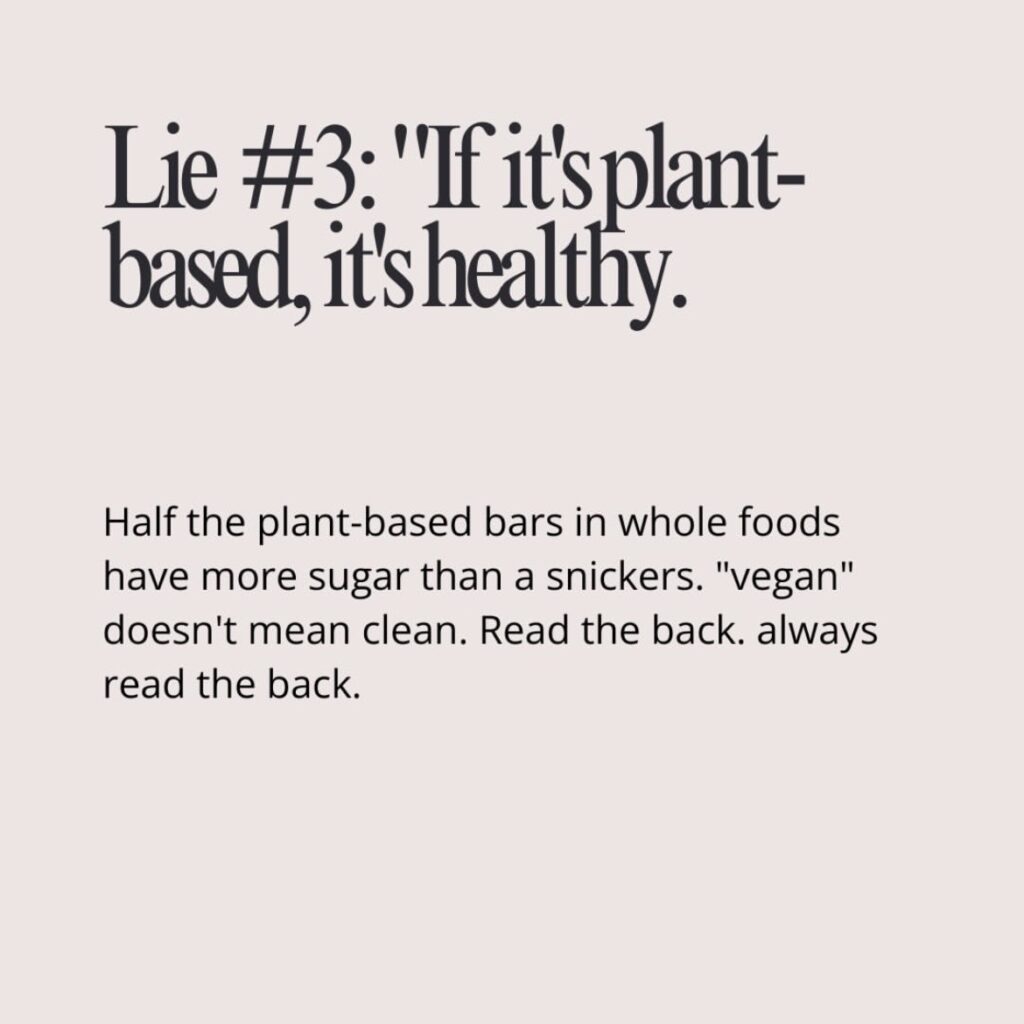
Lie #3: “If It’s Plant-Based, It’s Healthy”
This one took me the longest to unlearn. Plant-based has been positioned as a moral category, clean, virtuous, automatically better. And the food industry took full advantage.
Walk down the bar aisle at Whole Foods right now. Pick up any “plant-based” or “vegan” snack bar and flip it over. Half of them have more sugar than a Snickers. They’re loaded with refined oils, isolates, gums, and sweeteners with names that sound natural but behave like sugar in your body. The label says “plant-based, gluten-free, organic” on the front, and you assume that’s all you need to know.
Read. The. Back.
Always read the back. “Vegan” doesn’t mean clean. “Plant-based” doesn’t mean low sugar. “Natural flavors” doesn’t mean what you think it does. A short, recognizable ingredient list is worth more than any front-of-package marketing claim. If you can’t pronounce half the ingredients, or if sugar (in any of its 60+ aliases, cane juice, brown rice syrup, agave, coconut sugar, dextrose) is in the top three, that’s information.
This is one of the reasons we built Joulebody the way we did. Every ingredient earns its place. You can look at the list and know exactly what’s in there and why. Real food, doing real work in your body, with no hiding behind buzzwords.
Lie #4: More Supplements = Better Health
Your supplement cabinet is probably out of control. Most people are. Magnesium for sleep. Ashwagandha for stress. Sea moss because TikTok said so. Two different multivitamins. Three different greens powders. Collagen. B12. Probiotics. A new mushroom complex you ordered after seeing an ad.
Here’s the truth: most of what’s in those bottles is going straight through you. Most of your supplement cabinet is expensive pee.
This isn’t because supplements are useless; they’re not. It’s because:
Your body can’t absorb nutrients well without baseline gut health. If your gut is inflamed, your absorption is compromised, and you’re throwing nutrients at a leaky system.
Most cheap supplements use the cheapest forms of nutrients (magnesium oxide instead of magnesium glycinate, folic acid instead of methylfolate, etc.), and your body either can’t use them well or actively struggles with them.
You don’t need 14 pills. You need three things working consistently:
Real food. Whole, nutrient-dense, recognizable. Most of what your body needs comes from food first.
Real sleep. Seven to nine hours, consistent timing, dark room. No supplement on Earth can outperform proper sleep.
Real minerals. Magnesium, zinc, iron (if needed), and trace minerals are usually the only handful that’s actually worth supplementing for most women, and even those are better when delivered through food and high-quality sources.
Get the foundations dialed in first. Then add a supplement or two strategically, based on what your body and your bloodwork are actually telling you. Not based on what an influencer is being paid to recommend.
Lie #5: Discipline Is the Answer
This is the one I want to leave you with, because it changed how I approach my own health more than anything else.
The wellness world loves to talk about discipline. Push through. Stick to the plan. Don’t break the streak. Be hardcore. And for some people, in some seasons, that works for a while. But for most women, especially women juggling work, family, hormones, and the actual texture of a real-life discipline is exhausting. It’s white-knuckling. It’s gritting your teeth through a green juice you hate, forcing a workout you dread, restricting food on a Tuesday because Monday was “bad.”
It’s not sustainable. And the second life gets hard, the discipline cracks, and you’re back at square one, feeling like you failed (when really, the system was never built for the long game).
The truth: ritual is what works.
Discipline says I have to. Ritual says I get to.
Discipline is something you do to yourself. Ritual is something you do for yourself.
A discipline-based wake-up is forcing yourself out of bed for a workout you hate. A ritual-based wake-up is the cup of tea you make a certain way every morning, the stretch you genuinely look forward to, the moment by the window that feels like yours.
A discipline-based diet is based on rules and restrictions. A ritual-based way of eating is real food, prepared with love, in patterns that honor your body and your cycle.
This is the entire philosophy behind Joulebody. Real food, in the form of rituals bars, bites, teas, powders, designed to be the kind of thing your body looks forward to, not the kind of thing you white-knuckle through. One is exhausting. The other is sustainable. And sustainable is the only thing that builds the long-term version of you that’s actually well.
So Which One Did You Believe the Longest?
If your answer is “all of them,” you’re in very good company. Most of us were sold these stories before we even knew we were buying them. The work isn’t to feel bad about that. The work is to slowly, gently, replace each one with what’s actually true.
Start with one. Maybe it’s adding real protein to your breakfast. Maybe it’s letting yourself eat in your luteal phase without guilt. Maybe it’s reading the back of every label this week. Maybe it’s clearing out the supplement cabinet and trusting real food. Maybe it’s swapping a discipline for a ritual.
Pick one. Practice it. Let it become normal. Then pick the next.
Your body has been listening to you this whole time. The minute you start telling it the truth, it starts trusting you back.
Want to swap a discipline for a ritual? Find your Joulebody Ritual here.
And if you missed the original IG carousel that started this whole conversation, come find us over on Instagram. We’re talking about this stuff every day.