
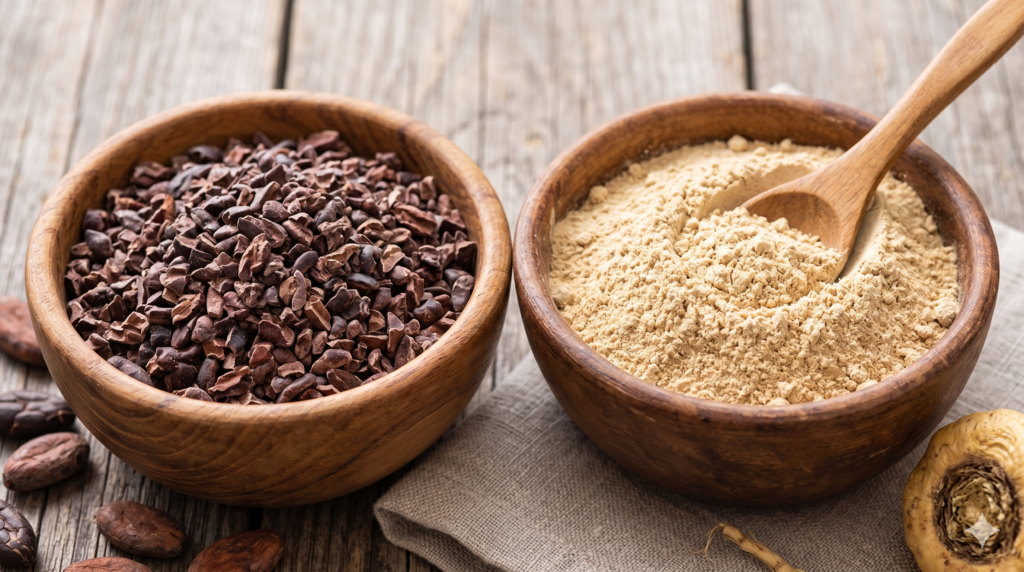
You’ve seen the labels. “Supports hormone health.” “Hormone-balancing.” “Adaptogenic.” It’s everywhere right now. But here’s the thing nobody really explains: what does that actually mean? An ingredient doesn’t just walk up to your hormones, hand them a balance sheet, and say “fix yourselves.” So what’s actually happening in your body when something is described that way? Let’s get specific. We’re going to look at two of the most beloved hormone-supportive ingredients out there — cacao and maca — and break down what they’re doing inside you, why your body responds to them, and how to actually use them.
First: What Does “Hormone-Supportive” Even Mean?
Most foods don’t contain hormones. (Dairy and certain animal products do, but that’s a different conversation.) When an ingredient is called “hormone-supportive,” what’s usually meant is one of these things:
It gives your body the raw materials to make hormones. Hormones are built from things like cholesterol, fatty acids, amino acids, and a whole supporting cast of vitamins and minerals. Magnesium, zinc, B vitamins, omega-3s — your endocrine system runs on these. Without them, hormone production stalls.
It supports the systems that regulate hormones. Your liver, gut, and adrenals do a huge amount of hormone-related work — making them, using them, breaking them down, and clearing them out. Anything that supports those systems supports your hormones.
It’s adaptogenic. Adaptogens are plants that help your body cope with stress more efficiently. Since chronic stress is one of the biggest hormone disruptors out there (it hijacks the same building blocks your sex hormones need), adaptogens help by stabilizing your stress response so your body has the bandwidth to do everything else.
It supports gut health. This one gets overlooked. Your gut is where a lot of your hormones are processed and recycled, especially estrogen. We’ve talked about this before in 3 Ways Your Gut Affects Your Hormones – a sluggish gut means hormones don’t get cleared properly, and that can throw the whole system off.
So when we talk about cacao and maca being hormone-supportive, that’s the lens. Now let’s get into what each one is actually doing.
Cacao: The Magnesium-Rich Mood Lifter
Cacao (the raw, unprocessed form of what eventually becomes chocolate) is one of the most nutrient-dense foods on the planet. It’s been used ceremonially for thousands of years, and there’s a reason your body responds to it the way it does. It’s not just a treat — it’s loaded with the exact minerals your hormones need.
Magnesium
Cacao is one of the highest natural sources of magnesium you can eat. Magnesium is a hero mineral for hormone health. It supports progesterone production, calms the nervous system, helps regulate cortisol, eases PMS symptoms, and is required for over 300 enzymatic processes in the body. Most women are walking around magnesium-deficient and don’t know it. If you crave chocolate around your period, that’s often your body asking for magnesium.
Iron and zinc
Cacao is rich in both. Iron supports healthy energy and oxygen transport (especially important during menstruation when iron stores can take a hit). Zinc plays a major role in progesterone production and is critical for ovulation.
Mood and serotonin
Cacao contains compounds — including theobromine, anandamide, and PEA — that gently lift mood, improve focus, and increase blood flow. It also helps support serotonin and dopamine, which are deeply intertwined with how you feel during your cycle. This is part of why a square of dark chocolate genuinely does something for you in the luteal phase.
Anti-inflammatory polyphenols
Cacao is loaded with flavonoids that fight inflammation. Since chronic inflammation is one of the biggest underlying drivers of hormone imbalance, anything that brings inflammation down is doing your hormones a favor.
The catch: most “chocolate” you see in stores is heavily processed, full of refined sugar, and stripped of the actual cacao benefits. To get the hormone-supportive payoff, you want raw cacao or cacao nibs — minimal processing, no junk added.
Maca: The Adaptogen That Doesn’t Push Hormones, It Supports the System That Makes Them
Maca is a root vegetable that grows in the Andes of Peru, traditionally used for energy, stamina, fertility, and mood. It’s having a moment in the wellness world right now, and it’s earned it — but there’s also a lot of bad information floating around about how it works. Let’s clear it up.
Maca doesn’t contain hormones. That’s actually the point.
A lot of people assume maca works by “adding” estrogen or progesterone to your body. It doesn’t. Maca is an adaptogen — meaning it works on the HPA axis (hypothalamus-pituitary-adrenal axis), which is the master communication system between your brain and your hormones.
When your HPA axis is stressed, dysregulated, or burned out, your body has a harder time making and balancing hormones. Maca supports the HPA axis so the whole system can function more smoothly. This is why people report so many different benefits from maca — better energy, better mood, more regular cycles, stronger libido — because it’s not targeting one hormone, it’s helping the whole system run better.
Energy without caffeine
This is one of the most loved benefits. Maca gives you steady, sustained energy without the spike-and-crash of caffeine. It doesn’t mess with your sleep, doesn’t dehydrate you, and doesn’t push your adrenals further into burnout. For anyone trying to get off the second-coffee habit, it’s a beautiful swap.
Mood and libido
Maca has been studied for its effects on mood and sexual function in both men and women, with research suggesting genuine benefits for libido, mood, and a sense of vitality. A lot of women find this shows up especially in the second half of the cycle, when energy and libido tend to dip naturally.
The three colors of maca
Here’s a detail most people miss: maca comes in different colors, and they have slightly different profiles. Yellow maca is the most common and is great for energy and overall hormonal balance. Red maca has been studied more for women’s hormone health, bone density, and mood. Black maca tends to be researched for stamina, focus, and male hormonal health, but is also used by women. Many high-quality maca products use a blend of all three for full-spectrum benefits.
A note on “starting slow”
Maca is potent. If you’ve never taken it before, start with a small amount (around half a teaspoon) and work your way up. Some people feel an effect immediately, others need a few weeks of consistent use. And like most adaptogens, it works better with consistency than in spurts.
How to Actually Use Cacao and Maca in Your Day
You don’t need a complicated supplement stack. The most effective way to use these ingredients is to fold them into something you already do every day. A morning smoothie, a warm afternoon drink, a snack — it all counts.
A few simple ideas:
A morning smoothie with banana, almond milk, a tablespoon of cacao, a teaspoon of maca, and a handful of greens. A warm cacao-maca latte instead of your second coffee. A piece of dark chocolate (70%+) and a maca-spiked cup of warm milk in the afternoon. A Joulebody bar or energy bites that already has these ingredients built in (so you don’t have to think about it).
The point is consistency. Hormone support doesn’t happen from a single dose of something — it happens from giving your body what it needs, regularly, over time.
The Bottom Line
When you see “hormone-supportive” on a label, it’s not magic. It’s an ingredient that delivers the minerals, adaptogenic support, and anti-inflammatory compounds your body needs to do its hormone work well. Cacao gives you magnesium, zinc, mood-lifters, and inflammation-fighters. Maca supports your HPA axis and steadies the whole hormonal system from the top down.
Together, they’re one of the most effective and pleasurable ways to support your hormones from the inside out. No prescription, no complicated protocol — just real food, doing what real food has always done.
Want to see exactly what’s inside our Rituals – and how every ingredient earns its place? Explore our ingredients